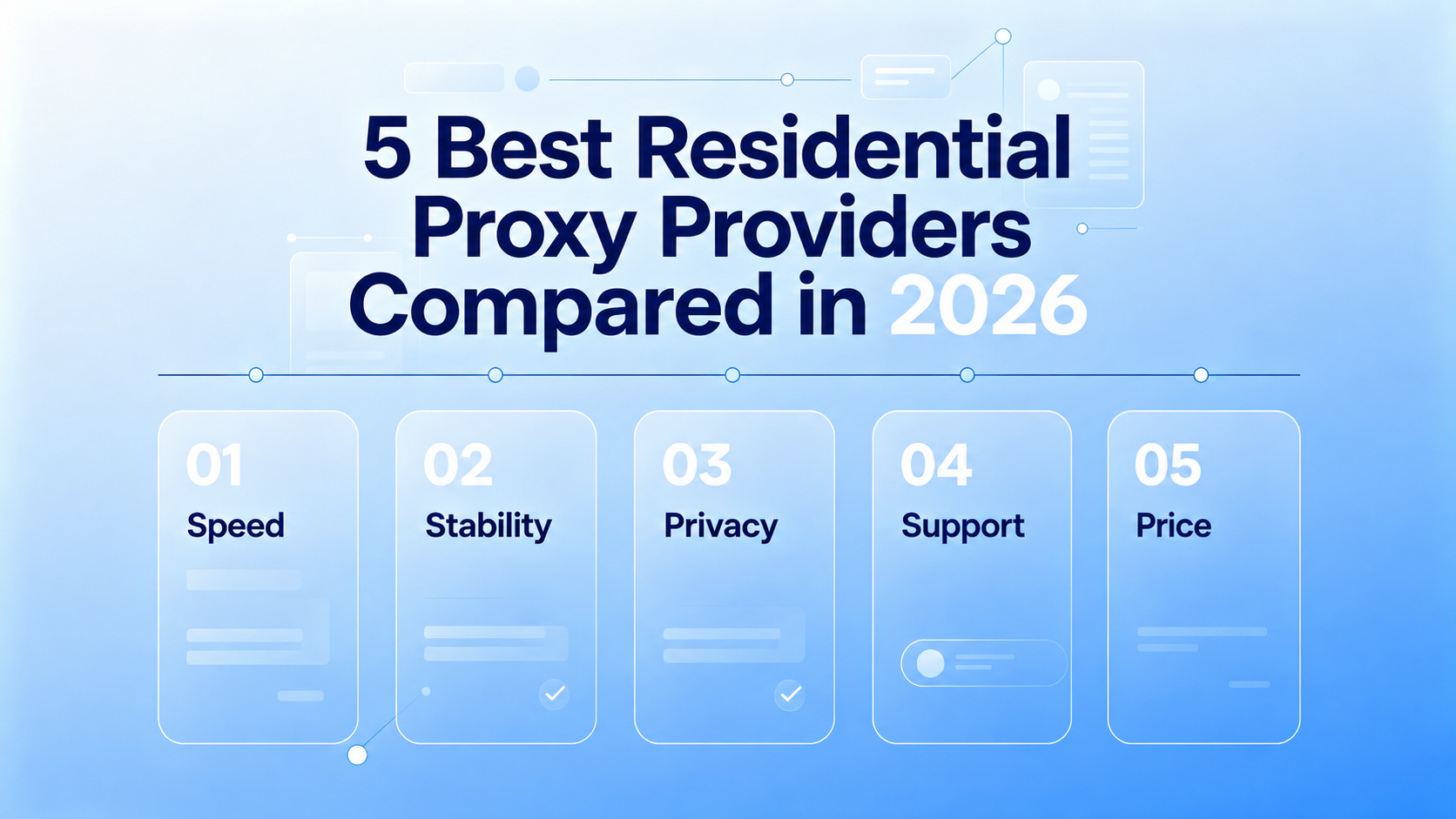
5 Best Residential Proxy Providers Compared in 2026
Anti-bot systems got materially harder in 2026. Google, Amazon, TikTok and most major marketplaces now stack CAPTCHA, IP reputation scoring and browser fingerprinting, and low-quality proxy pools no longer get through. Which provider you pick now decides whether your pipeline runs at all.
This ranking scores vendors on what actually breaks in production: high block rates, hidden extra fees, unstable global IP coverage and inflexible billing rules. Whether you need dynamic residential IPs for bulk crawling or static ISP IPs for well-defended marketplaces, it will get you to a shortlist.
Top Picks at a Glance
How We Evaluated
We assessed every provider against 9 weighted criteria covering network, performance, session control, commercial terms and access.
- Request success rate
- Network uptime
- Sticky session duration
- Network scale & coverage
- Global geo-targeting capability
- IP pool size
- Pricing transparency & cost efficiency
- Product line breadth
- Compliance & ethical IP sourcing
The 5 Best Residential Proxy Providers
Capability Comparison
Commercial Comparison
IPOasis: Best for cost-predictable, long-running jobs
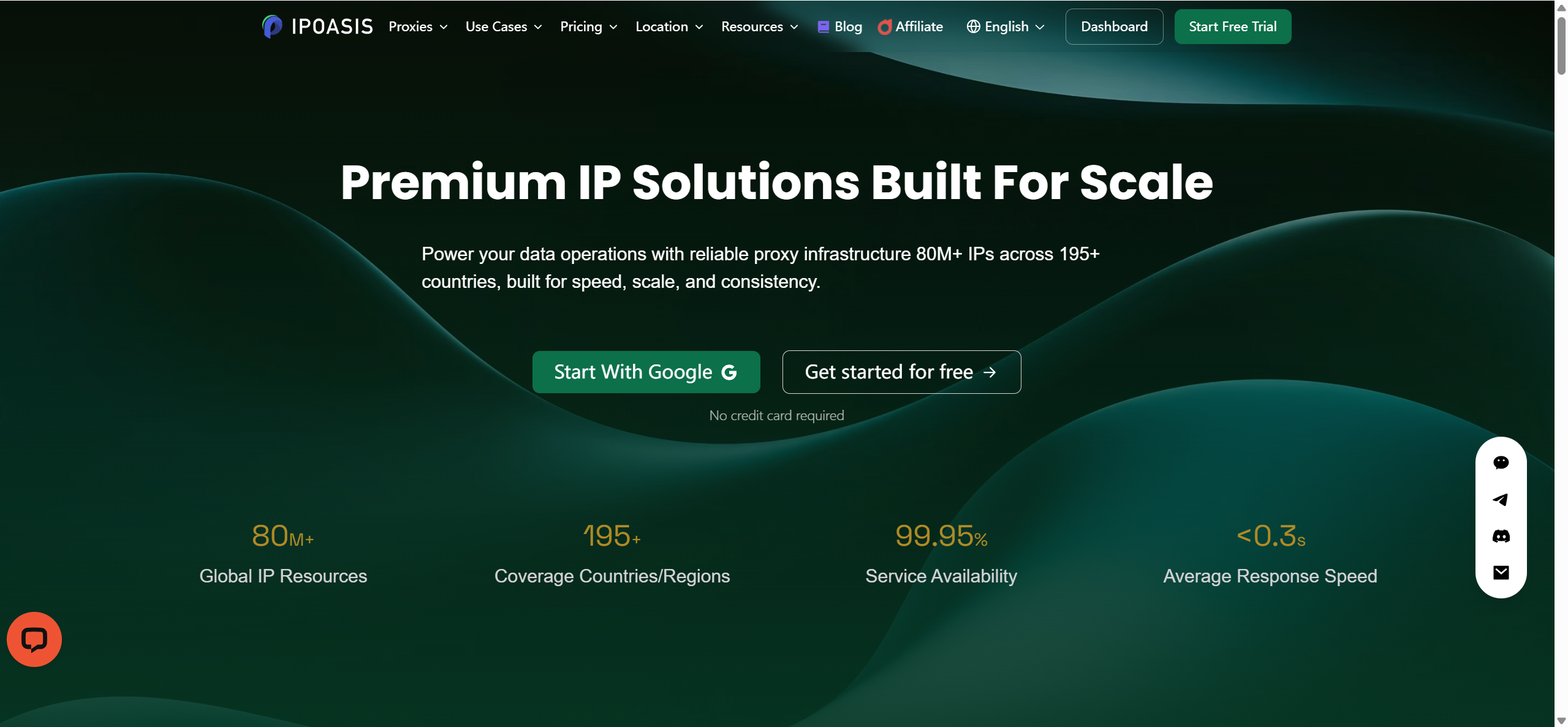
Best for: Teams whose bandwidth use is uneven — scrapers that idle between campaigns, seasonal price monitoring, research projects that stop and start.
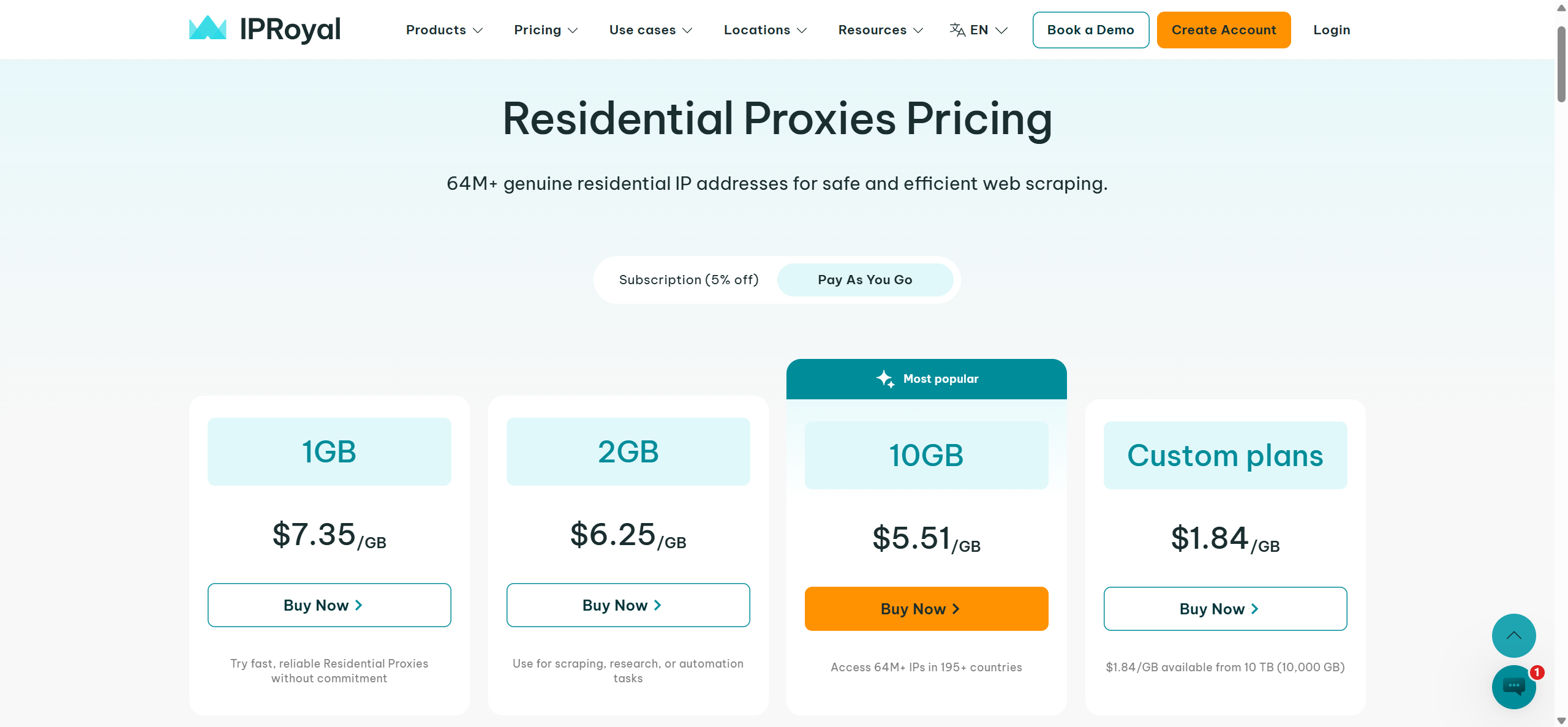
Where it leads: Two things are true at once here and nowhere else in this list: traffic bought by GB never expires, and the entry rate is $1.99/GB with no commitment. IPRoyal also sells never-expiring traffic, but its comparable small-volume rates start at $5.25–$7.35/GB; the $1.75 tier requires a 10 TB purchase. Bright Data, Oxylabs and Decodo do not have an expiry policy at all.
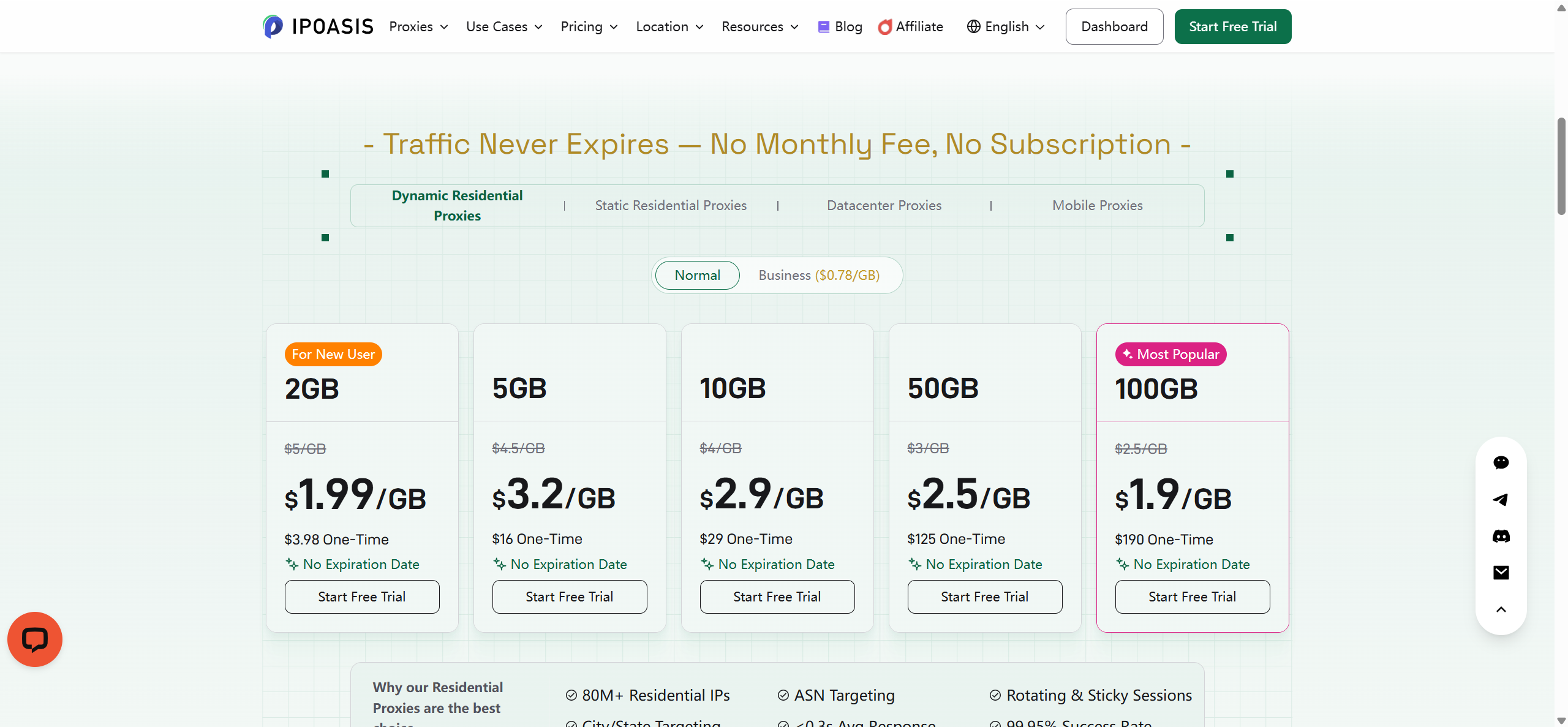
Performance: 99.95% success rate — level with Bright Data and Oxylabs, the highest published figures in this list. Uptime is at 99.9%.
Conclusion: Cheapest way to hold bandwidth you will not use immediately, and the easiest to trial without talking to sales.
Bright Data: Best for pool size and enterprise compliance
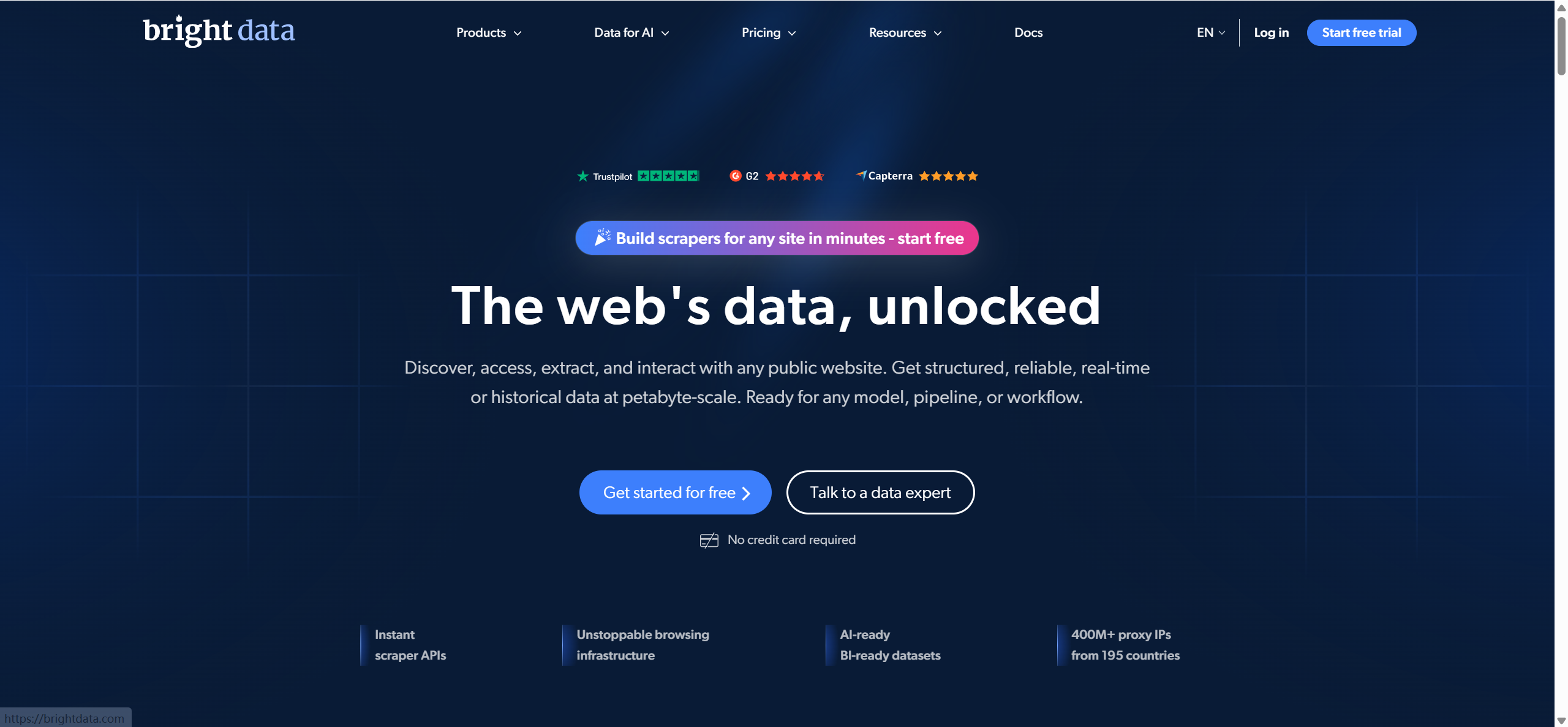
Best for: Enterprises that need audit-ready compliance and the widest possible IP coverage.
Strengths: The largest advertised pool at 400M+ monthly IPs across 195 countries, the most granular targeting in the list (city, state, ZIP, ASN and carrier, all free), and the only provider here referencing a contractual SLA — 99.99% uptime with 15-minute priority response. Certifications listed include ISO 27001, SOC 2, SOC 3 and CSA STAR Level 1. Free trial requires no credit card.
Weaknesses: The most expensive entry point by a wide margin: $8.00/GB pay-as-you-go, or $4.00 with a promotional coupon. Reaching $2.50/GB requires the $1,999/month plan. No published traffic expiry policy.
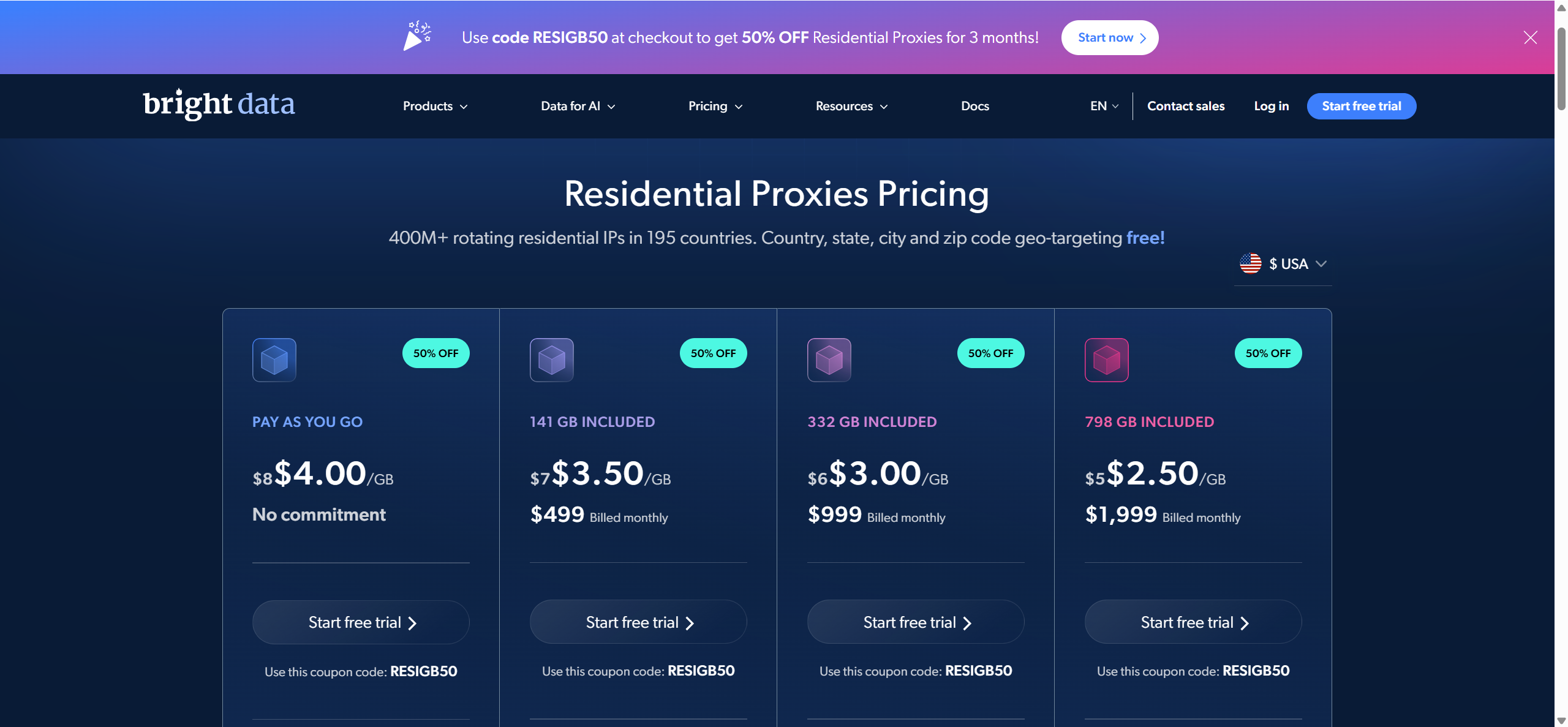
Conclusion: If procurement needs certifications and an SLA, this is the shortlist. If cost per gigabyte is the constraint, it is the wrong end of the market.
Oxylabs: Best for deep geo and ASN targeting
Best for: Localisation-heavy work — ad verification, SERP monitoring by city, price checks across regions.
Strengths: The most complete targeting filter set published by anyone here: country, city, state, continent, ZIP, coordinates and ASN, plus OS and platform filters, all free. 175M+ IPs across 195+ countries, 99.95% success rate, 24-hour sticky sessions, unlimited concurrent sessions, and a dedicated account manager on every tier.
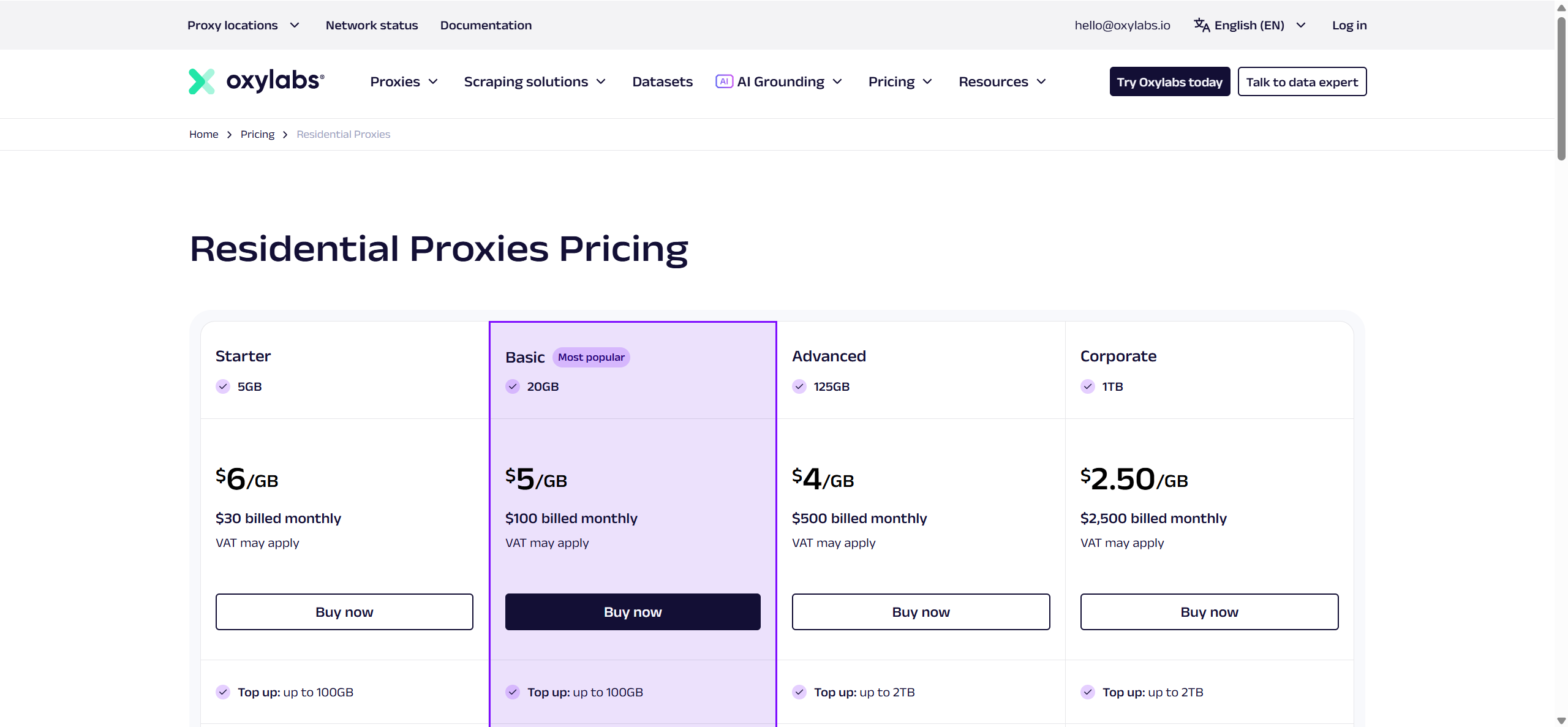
Weaknesses: No uptime figure published on the residential page. The free trial is available on request only and once per client. Pricing starts at $6.00/GB for 5GB; $2.50/GB needs a $2,500/month commitment. Advanced filters may require KYC verification. We also found an inconsistency between the pricing table and the FAQ on the same page, which is worth confirming with sales.
Conclusion: Best targeting documentation in the list. Priced for teams that need it.
Decodo: Best mid-tier price-to-feature ratio
Best for: Small and mid-size teams that want most of the enterprise feature set without enterprise pricing.
Strengths: 115M+ ethically-sourced IPs across 195+ locations, with city, ZIP and ASN targeting included in every plan at no extra charge. Published 99.99% uptime and 99.92% success rate, sub-500ms response.
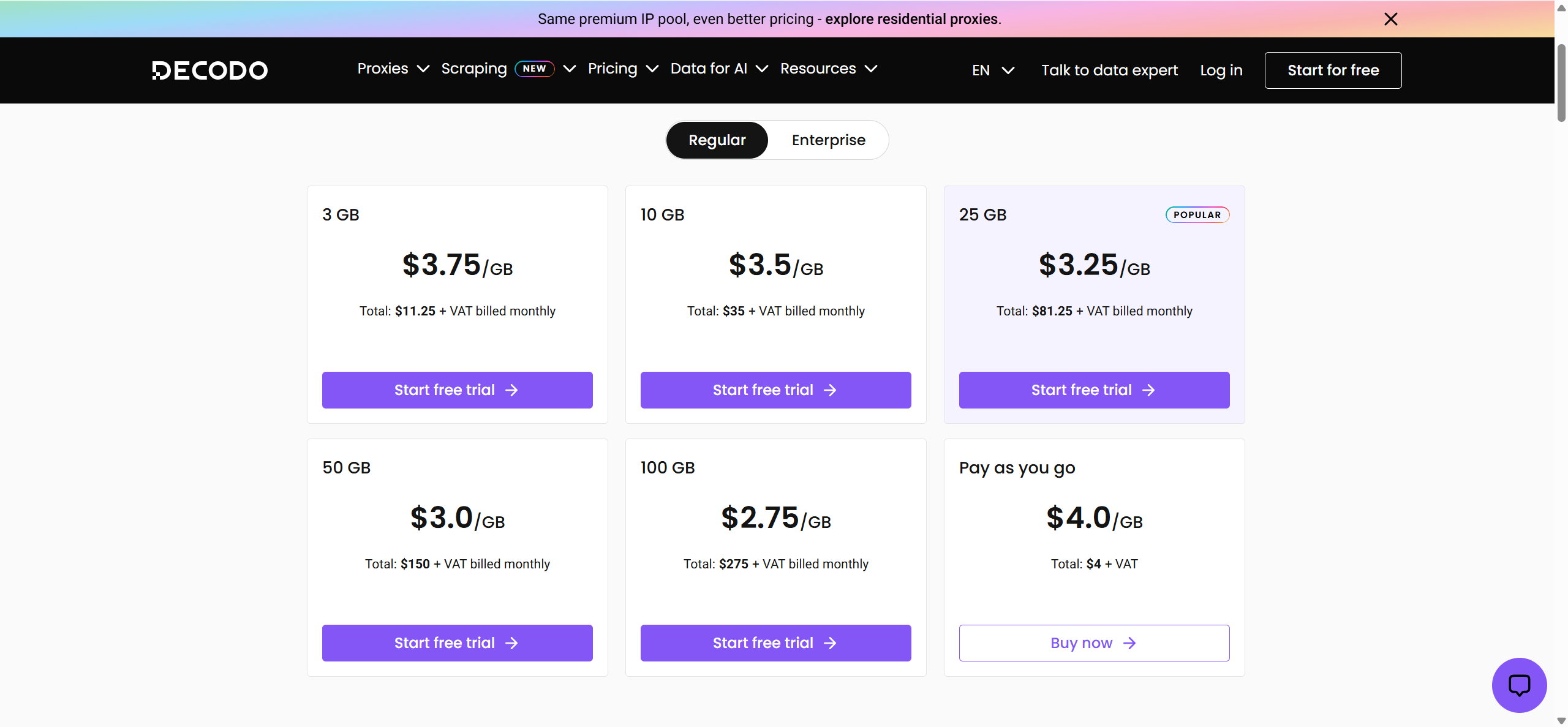
Weaknesses: The advertised $2.00/GB is an enterprise 1000GB tier; realistic public pricing is $2.75–$4.00/GB. No published sticky session cap. No published traffic expiry policy.
Conclusion: The strongest all-round option in the middle of the market.
IPRoyal: Best for never-expiring traffic at small volumes
Best for: Startups, researchers and small data teams buying in small amounts with no contract.
Strengths: The only provider here besides IPOasis to state clearly that unused traffic never expires. Pay-as-you-go from 1 GB with no commitment, the longest sticky sessions in the list at 7 days, and 64M+ IPs across 195+ countries.
Weaknesses: The lowest published success rate here at 99.4%, and 99.9% uptime with no SLA referenced. Geo-targeting is documented only to country, state and city — no ASN or ZIP. Small-volume pricing is high at $5.25–$7.35/GB, and the headline $1.75/GB requires a 10 TB purchase. Free trial terms are not published.
Conclusion: A good fit if you need traffic that keeps and you are buying single gigabytes. Weaker on targeting depth and on published performance figures.
How Do You Actually Compare Residential Proxy Pricing?
The advertised price per gigabyte is the least reliable number on any proxy pricing page, for three reasons.
Failed requests cost the same as successful ones
Bandwidth is billed on data transferred, not on outcomes. A provider quoting $2.50/GB at a 99.4% success rate and one quoting $2.50/GB at 99.95% are not selling the same thing.
The figure that matters is cost per successful request:
Cost per successful request = (price per GB × avg payload in GB) ÷ success rate
At a 200 KB average response and $2.50/GB:
At this payload size the difference is under a cent per thousand requests — which is the honest answer. Success-rate differences in the 99.4–99.95% band are not where your money goes. Retry logic absorbs them.
The headline rate usually needs volume you do not have
Four of the five providers here advertise a "from" price reachable only at high volume:
Compare the tier you will actually buy, not the tier in the hero image.
Expiring bandwidth is a real cost, and nobody prices it
This is the variable most comparisons skip. If you buy 100 GB and use 60 GB before the balance resets, your effective rate is not the sticker price — it is the sticker price divided by your utilisation.
For steady, predictable workloads this does not matter. For anything seasonal, project-based or still being scoped, it is often the largest single line item — and it is the reason expiry policy belongs in the comparison table, not the footnotes.
Only IPOasis and IPRoyal publish a no-expiry policy. Bright Data, Oxylabs and Decodo do not address it on their product pages, which means you should ask before buying rather than assume either way.
Which Provider Fits Your Use Case?
Residential vs ISP vs Datacenter vs Mobile
If your targets are public APIs, documentation sites, or anything without bot protection, datacenter proxies will do the same job at a fraction of the cost. Residential IPs earn their price only against sites that actively fingerprint and block.
If you need the same IP held for days rather than rotated, static residential (ISP) is usually the better and cheaper answer than paying rotating-residential rates and pinning a session.
Four Mistakes People Make When Choosing a Provider
- Ignoring how long unused traffic stays valid. If your usage is uneven, expiry policy can move your effective cost more than the per-gigabyte rate does. Ask for it in writing — three of the five providers here do not publish it.
- Ranking providers by pool size. Advertised pools are counted differently by every vendor — some monthly, some quarterly, some multiplied by exit nodes. A larger number does not mean more IPs available to you in the country you need. Ask for concurrent available IPs in your target geography instead.
- Comparing the headline price per gigabyte. As shown above, the advertised "from" rate usually requires a volume commitment you will not make. Compare the tier you will actually buy.
- Treating the free trial as a production test. A 3-day, 100 MB trial tells you the endpoint works. It tells you nothing about block rates at scale or performance during peak hours. Budget for a small paid pilot before committing to an annual plan.
Frequently Asked Questions
What is the best residential proxy provider in 2026?
There is no single best provider, because the deciding variable differs by workload. Bright Data leads on pool size and compliance documentation, Oxylabs on targeting depth, Decodo on mid-tier value, and IPOasis on cost predictability for uneven usage. Match the provider to the one constraint that actually binds your project rather than to an overall ranking.
How much do residential proxies cost per GB?
Published entry rates among the five providers compared here range from $0.78/GB to $8.00/GB as of August 2026. Advertised "from" prices of $1.75–$2.50/GB generally require volume commitments between 1 TB and 10 TB. For small-volume buyers, realistic pricing sits between $2.75 and $7.35 per gigabyte.
Are residential proxies legal to use?
Using residential proxies is legal in most jurisdictions. Legality depends on what you do with them: accessing publicly available data is generally permitted, while bypassing authentication, violating a site's terms of service, or collecting personal data without a lawful basis is not. Check the target site's terms and your local data protection law before starting.
Do unused proxy GBs expire?
It depends on the provider, and most do not publish a policy. Among the five compared here, IPOasis and IPRoyal both state that traffic never expires. Bright Data, Oxylabs and Decodo do not address expiry on their product pages, so confirm with sales before purchase. If your usage is seasonal or project-based, this single term can change your effective cost more than the headline rate.
What is the difference between rotating and static residential proxies?
Rotating residential proxies assign a new IP per request or per interval, which suits large-scale scraping where each request should look independent. Static residential (ISP) proxies hold one IP indefinitely, which suits account management and any workflow that must appear as the same returning user. Rotating is priced per gigabyte; static is usually priced per IP per month.
Conclusion
In 2026, the core competitiveness of the best residential proxy providers is no longer simply judged by the total number of IP pools. Legal and compliant IP sources, transparent and flexible pricing rules, granular city-level geo-targeting and reliable rotation and retry handling are the key factors separating high-quality commercial proxy networks from risky low-cost products.
IPOasis matches the highest published success rate in this list while pricing below the enterprise tier, with no minimum commitment and traffic that does not expire, making it the most cost-effective residential proxy provider you can trust.