403 Forbidden Cloudflare: Why Scrapers Get It
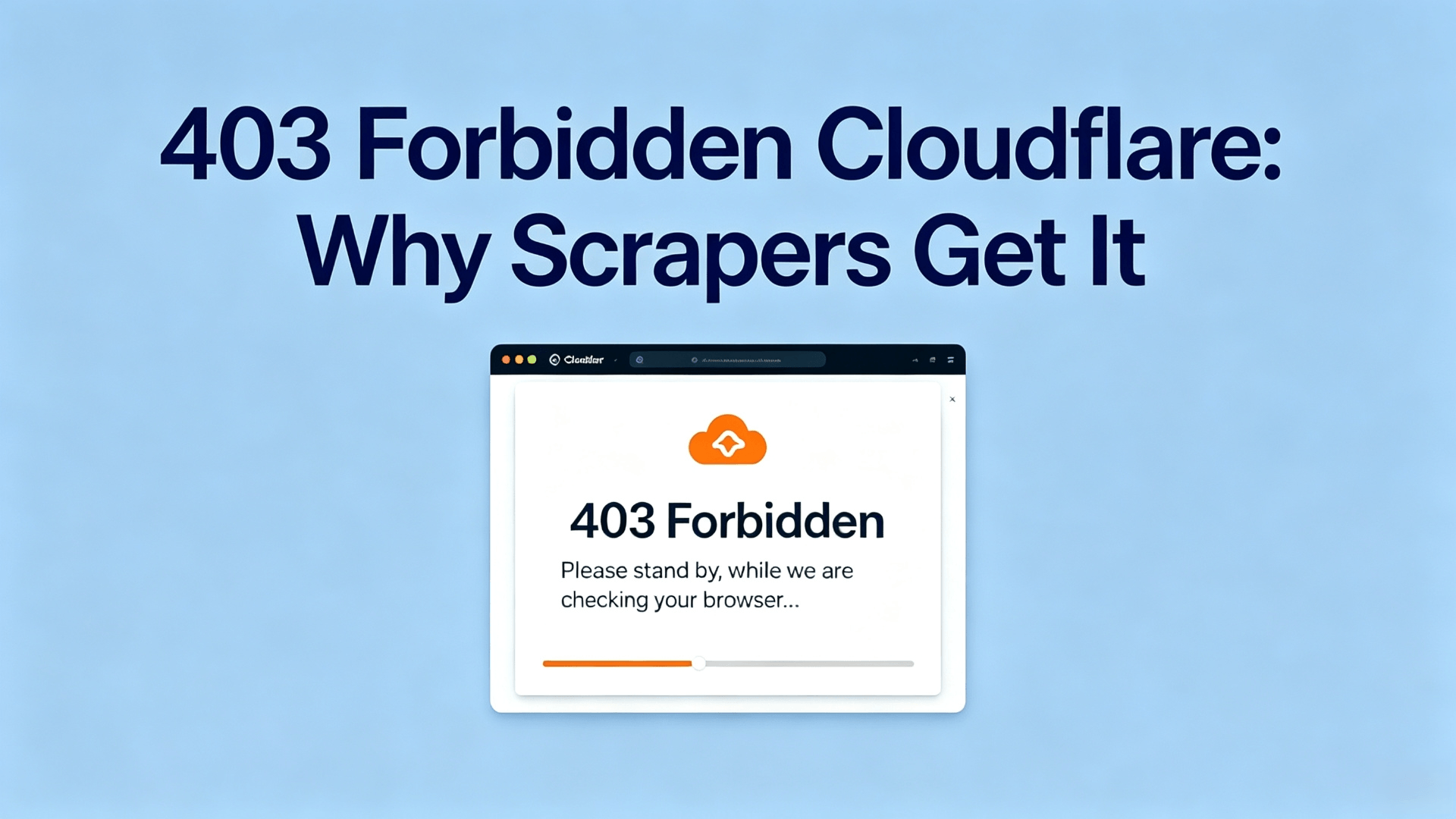
A 403 Forbidden Cloudflare response means the edge understood the scraper request and refused it. It is not a missing page. Datacenter exits, Python TLS fingerprints, and fast IP rotation are the usual triggers. Log status, body, and cf-ray first. Recover on a sticky residential session, then rotate between jobs.
Key Takeaways
- HTTP 403 means refused. It does not mean the URL is gone.
- Read the body and cf-ray before you swap IPs.
- Datacenter exits and library TLS often fail together.
- Sticky residential session, for one scrape job.
What 403 Forbidden Cloudflare means for a scraper
403 Forbidden Cloudflare is an HTTP 403. The server understood the request and refused it. Cloudflare’s 403 docs say the same: understood, not allowed. For a scraper that usually means an edge rule, not a missing file. Cloudflare 403 is the same status with the words flipped.
A browser screenshot of a blank tab is not a diagnosis. Your script must print the status and a short slice of the body. A 404 would mean the path is gone. A 403 means the path was seen and denied.Public page monitoring is in scope. Do not steal another user’s session cookie. Do not drive a login wall that is not yours. Target terms may still forbid automation even when the HTTP layer recovers.
How do you tell origin 403 from a Cloudflare block?
An origin 403 is refused by the site’s own server. A Cloudflare block is refused at the edge. Official docs say a page with no Cloudflare branding usually came from the origin. A branded page, a Ray ID, or cf-mitigated points at the edge. A challenge page can still return 200 or 403 and still not be your JSON.
A cloudflare 403 forbidden page with branding is the edge refusing you. Site owners can open Security Events. Scrapers cannot. You only have the response in front of you.
If the HTML talks about Nginx permissions, you are on an origin ACL on Nginx, not an edge bot score. Changing residential IPs will not open that file.
Why do scrapers get Cloudflare 403?
A scraper gets Cloudflare 403 when the edge scores the client as a bot and chooses block instead of a puzzle. The score reads the exit IP, the TLS handshake, and how fast you repeat. A Chrome User-Agent on Python requests still looks like a library. A new residential IP does not hide that handshake.
Three layers show up on scrape jobs. Hosting ranges and burned exits fail first. Default requests and Scrapy TLS fail on every new IP. Burst traffic and rotate-every-request fail after a few 200s.
If every fresh IP 403s on request one, run the job in a real browser stack when every new IP still 403. Do not raise concurrency on the same handshake.
How do you diagnose the 403 before you change anything?
Diagnose here means recording what the edge returned before you rotate, retry, or buy another pool. Status code alone is too coarse. Save the status, a short body snippet, cf-ray, cf-mitigated, and server. That tells you origin vs edge vs challenge. Guessing from a screenshot wastes the next hour.
- Hit the target URL once. Do not loop retries.
- Print status, cf-ray, cf-mitigated, server, and content-type.
- Keep the first 200 characters of the body. Look for challenge HTML vs a plain 403.
- Match that output to the table above before you change the exit.
Use the HTTP client you already have. Python requests, curl, and Playwright all expose the same headers. Log the five fields. Do not add a second script.
If status is 403 and cf-ray is set, treat it as an edge refusal. If both are missing and the HTML talks about Nginx, go back to the origin row.
A 407 or a tunnel failure is proxy user, pass, or port. You have not reached Cloudflare yet. Check the exit IP before you retry if the tunnel itself is clean.
How do you recover a scraper after Cloudflare 403?
Recover means getting a 200 and the public page you asked for, on a job you are allowed to run. It is not a Cloudflare bypass. You change the exit class, keep one session, and slow the cadence. You do not click Turnstile in a tutorial, and you do not add a captcha farm. Target terms may still forbid automation.Use the diagnostic record, not a new guess.
- Origin 403: stop. This is not a proxy problem.
- Challenge HTML: you need a real browser session. Do not write a click path here.
- Datacenter hard 403: move to a residential exit.
- Every new IP 403s: change the TLS or browser stack. Do not add workers.
- A few 200s, then 403: keep one sticky session and slow the queue.
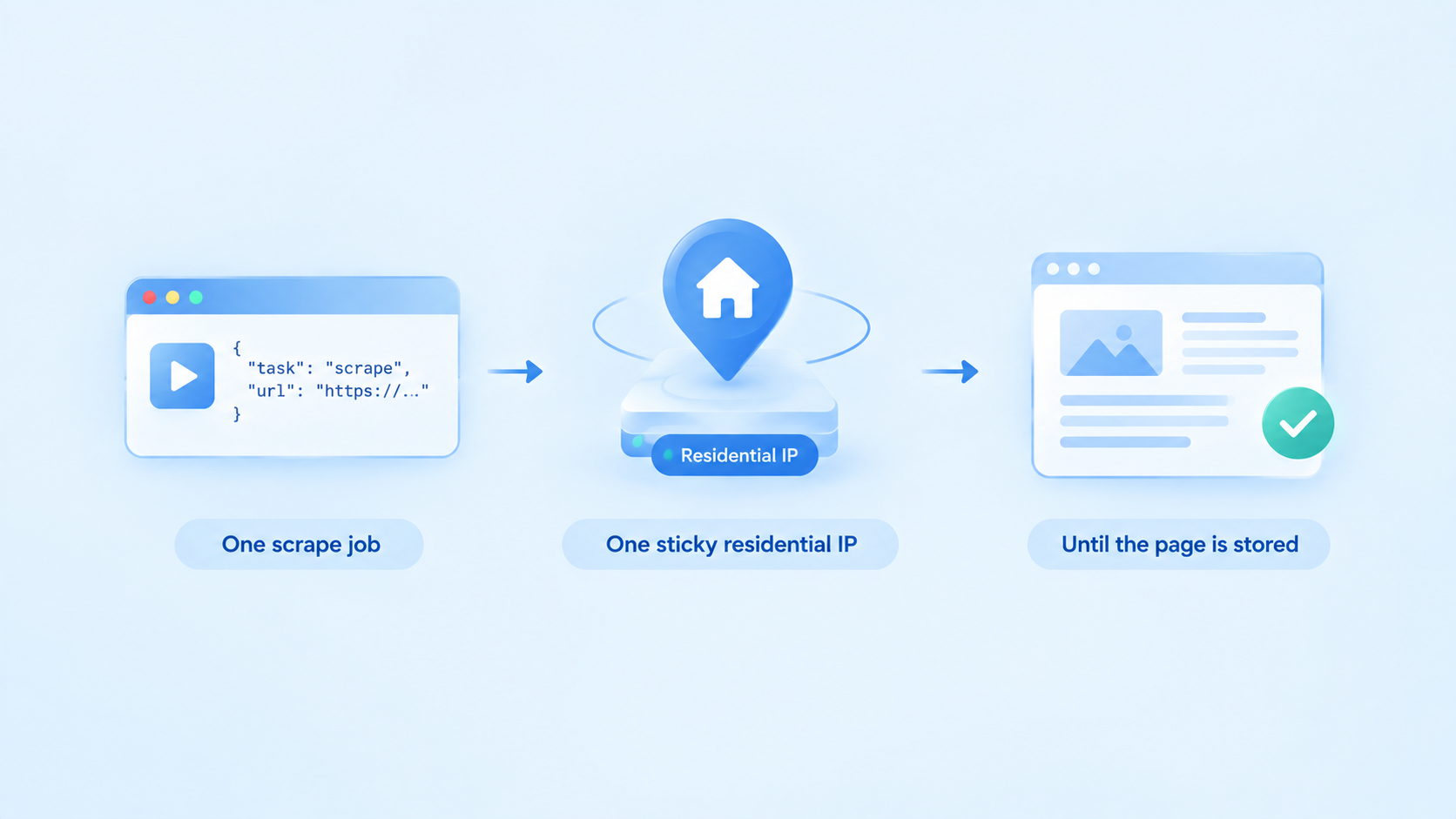
Sticky residential keeps one IP for one job. When the window ends, the IP can change. Open a new sticky session for the next job. Mid-job rotation drops cookies and looks like a new device.
Recover the job on a sticky residential session so one scrape keeps one exit until you store the page.
Teams that collect public pages without sharing one datacenter exit still pin one session per job. Match locale to the exit country.
Cloudflare 403 vs 1015 vs 1020 vs 429
These four responses all stop a scraper, and they are not the same refusal. 403 is permission denied. 1015 is Cloudflare rate limit copy. 1020 is a firewall rule match. 429 is HTTP too many requests, often from the origin. Mixing them makes you rotate IPs on a rate cap, or slow down on a hard WAF block.
A rate limit is 1015. Do not spend a new residential session on a cap that needs a pause.
FAQ
What does Cloudflare 403 Forbidden mean?
Cloudflare 403 Forbidden is HTTP 403 from the edge or the origin. The request was understood and refused. It is not a 404. For scrapers it is usually a WAF or bot rule, not a missing file. Read the body and cf-ray before you rotate.
Is Cloudflare 403 the same as a JS challenge?
No. A 403 can be a hard block with no puzzle. A challenge page may return 200 or 403 and still serve “Just a moment…” HTML. If you see cdn-cgi or Turnstile markup, you do not have a solved browser session. Do not treat that HTML as your JSON.
Can a datacenter proxy recover from Cloudflare 403?
Rarely on public targets. Hosting ASNs are scored first. Use datacenter exits on hosts you own, or to debug headers. After a 403 on a datacenter IP, move the job to sticky residential. Adding more datacenter IPs repeats the same ASN class.
How long can a sticky residential session last?
IPOasis's dynamic residential sticky sessions last up to 120 minutes. The IP can change when that window ends. Keep the same session for one scrape job. Start a new sticky session for the next job.
Why do I still get 403 after changing IP?
A new IP does not change the TLS handshake. Python requests and Scrapy still look like libraries. If every fresh residential IP 403s on the first hit, switch to a real browser stack. Do not raise concurrency. Log cf-ray on the new IP so you can see it is still the edge.
Is error status 403 Cloudflare the same as HTTP 403?
Yes. Error status 403 Cloudflare is HTTP 403. It is not a second status. Some logs print the words in a different order. Diagnose it the same way: status, body snippet, cf-ray, cf-mitigated. A 1015 rate-limit page is a different refusal.
Does rotating on every request fix Cloudflare 403?
No. Rotate-every-request drops cookies and looks like a new device. Jobs that got a few 200s then 403 need a sticky session and a slower cadence. Rotate between jobs after you store the page. Mid-job rotation often makes the next 403 arrive sooner.
Conclusion
Read the response before you change the exit. Keep one sticky residential session, until the job is stored. Recover the job on a sticky residential session when you pin the scrape.